
Everyone Needs to Take a Breath About AI

Updated: Jun 3
Let me say something that might be unpopular right now.
Everyone needs to calm down about AI.
Not because AI is not important. It is. Not because it is not transforming industries. It is doing that too. But the gap between the narrative and the reality on the ground is enormous, and I see it every single week.
I run AI strategy, productivity, and adoption workshops with companies across different sectors. And here is what I actually find when I walk into those rooms:
Most companies are not ready for AI transformation.
They are still writing AI policies. Their data structures are not set up for meaningful AI integration. Their teams have tried a few tools but have no consistent workflow. They are aware that something important is happening, but they are nowhere near the "AI is replacing everything" scenario that fills the news cycle.
So why does it feel like the world is on fire?
The FOMO machine is running at full speed
Here is the honest answer: tech companies need your fear.
When you are raising hundreds of billions of dollars to build data centres, you need a story powerful enough to justify those numbers. As Ken Griffin put it at Davos earlier this year, speaking before his recent change of heart on AI capabilities: "You're not going to generate this kind of spend unless you're going to make a promise you're going to profoundly change the world. How else are you going to get people to write $500 billion of checks just this year alone? There needs to be a level of 'AI is your saviour, almost.'"

That framing is deliberate. It is not neutral information. It is a narrative designed to keep capital flowing.
And it works, because FOMO is one of the most powerful psychological levers there is.
Last week I was on a panel at Queen Mary University
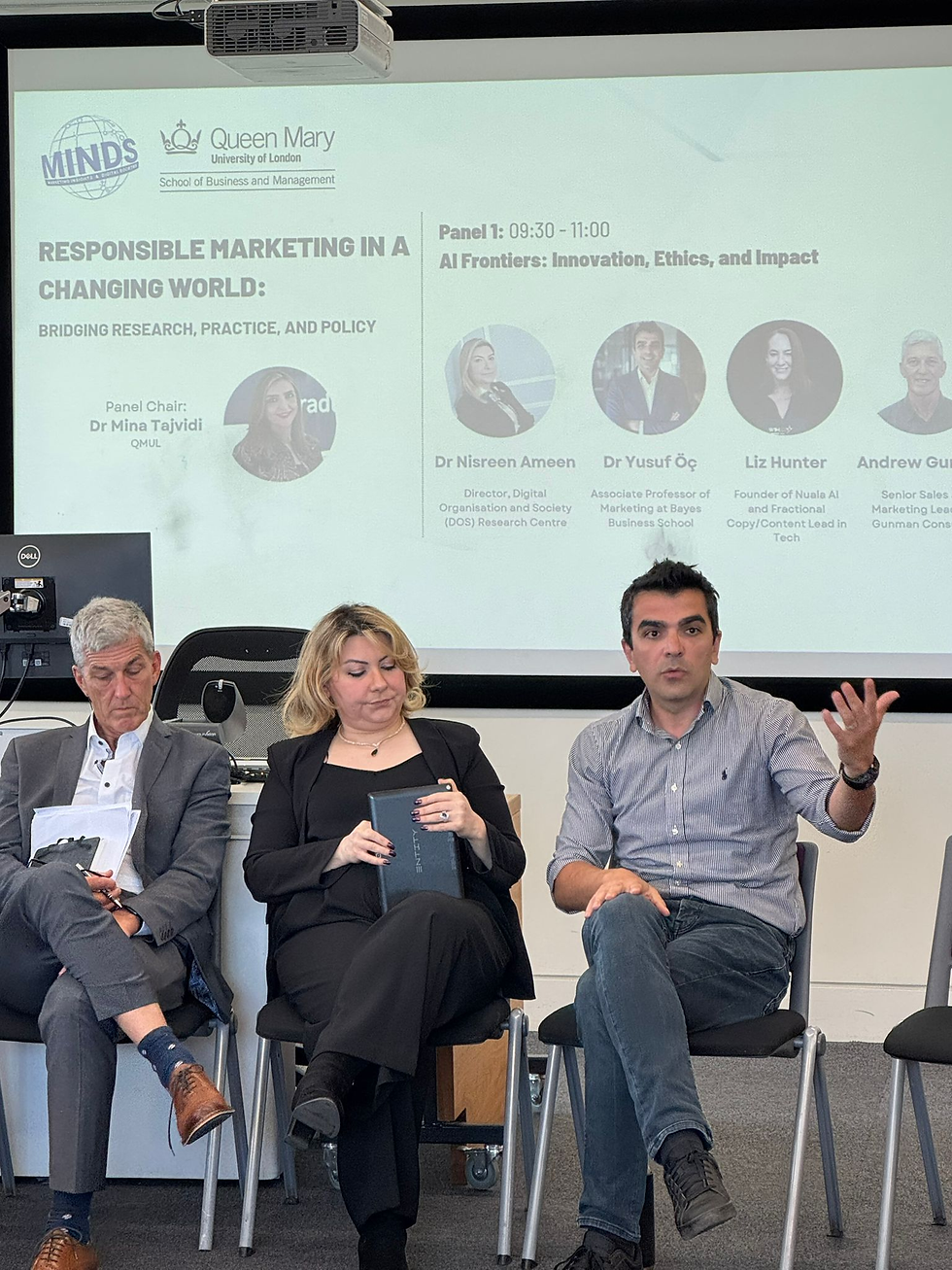
One of my fellow panellists made the claim that AI is responsible for a wave of mass layoffs happening right now.
I pushed back, respectfully.
Because the data tells a more complicated story.
Researchers at CNBC and economists from the New York Fed have found that only around 1% of services firms reported AI as the actual reason for laying off workers. Meanwhile, Fortune reported that companies attributed around 55,000 job cuts directly to AI in 2025, but that still represents just 4.5% of all job losses that year.
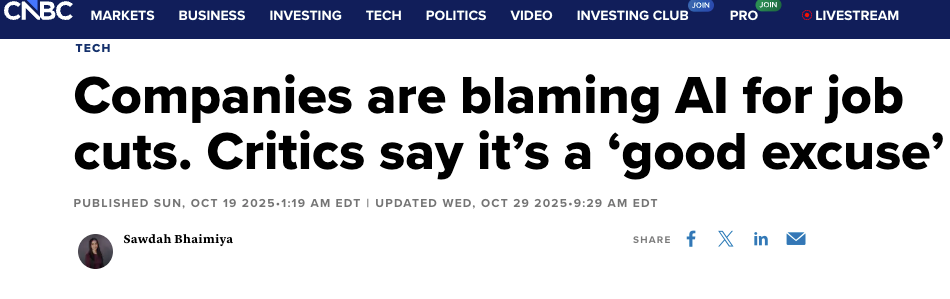
What is actually happening? Many economists and analysts argue that companies are using AI as a convenient narrative, a socially acceptable reason to do something they needed to do for other reasons entirely.
After the pandemic, many businesses hired aggressively. Growth forecasts were high. Then they were not. The post-pandemic correction was coming regardless. But "we over-hired during COVID and the growth did not materialise" is not a great headline. "We are investing in AI and transforming our business" is a much better one. As one analyst quoted by CNBC put it, companies are essentially "scapegoating" AI to conceal the real reasons for workforce decisions.
AI is being used as an excuse, not just as an engine.
And there is more. Klarna became the poster child for AI replacing workers, until the quality dropped, customers complained, and they had to quietly rehire. Amazon's much-hyped "Just Walk Out" AI-powered stores turned out to rely heavily on human workers reviewing footage remotely. The gap between the marketing and the mechanics is wide.
We have seen this before
Does this remind you of anything?
The dot-com bubble. Early internet days. Hundreds of companies jumped on the train: "We can sell everything online." Webvan, Kozmo, Pets.com. The ideas were not always wrong, they were premature. Most of the companies that chased the wave without understanding consumers went under.
The winners? The ones who focused not just on the technology, but on the fundamentals: understanding their customers, simplifying the experience, building real operational capability.
We are in a very similar moment right now. History is not repeating itself exactly, but it rhymes loudly. You can read my other short blog about this here.
So what should you actually do?
Here is the practical framing I use in my workshops:
Start with your own business, not with the general narrative.
AI is genuinely powerful in a few specific areas:
Internal productivity — research, drafting, summarising, automating repetitive tasks
Software and product development — faster prototyping, code generation, testing
Data and analysis — pattern recognition, segmentation, insight generation
These are real gains. They are meaningful. You should be capturing them.
But here is the nuance that gets missed: yes, AI has dramatically lowered the barrier to building software products. You can now clone almost any app or replicate a competitor's tool far faster than before. Sounds amazing, right?
It also means your competitors can do the same to you.
And then what separates you? The same things that have always mattered. Marketing. Brand trust. Customer relationships. Operations. Human support. The ability to understand what your specific customer actually wants.
We saw this with physical products decades ago. Anyone can produce a chocolate bar. Anyone can manufacture a blender. But building a brand that people choose, trust, and come back to, that requires completely different capabilities. The same logic now applies to software.
Lowering the entry barrier does not eliminate the competitive challenge. It just moves it downstream, straight into marketing, operations, and customer experience.
The people you should actually invest in
Here is the thing that frustrates me most about the current conversation.
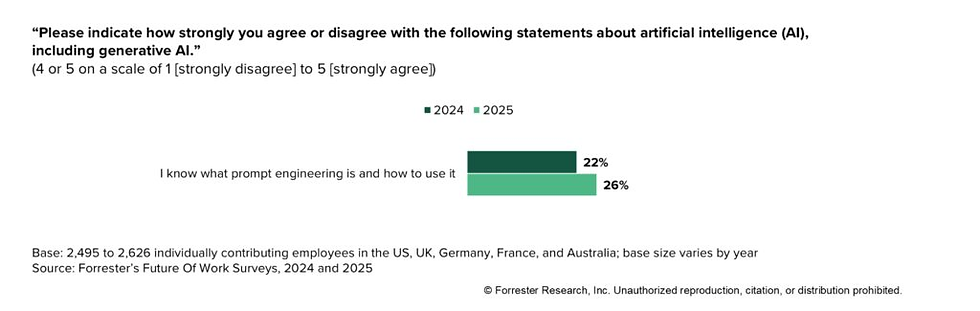
Companies are talking about replacing people with AI. But most of them are not even training their existing teams properly. Forrester found that only half of organisations offered meaningful prompt engineering training to their nontechnical employees in 2025. People are largely teaching themselves through trial and error.
The people who know your business, your customers, your market, they are your competitive asset. Not the AI tool itself. The tool is increasingly commoditised. Your team's judgement, context, and domain expertise are not.
Train the people who know your business. Help them use AI to extend their capability. That is how you build a durable advantage, not by cutting heads and hoping the tools fill the gap.
The practical question to ask right now
Forget the headlines. Forget the panic. You don't need to learn how to make funny videos with AI or put yourself in an astronaut costume or dance on the moon. Sit with this question instead:
What are the two or three specific tasks in my day-to-day work, or in my team's workflow, where AI could genuinely reduce friction or improve quality?
Start there. Build a repeatable workflow. Learn from it. Expand from there.
That is what the companies who will actually benefit from AI are doing right now. Not scrambling to transform everything overnight. Not making large structural decisions based on fear. Just systematically identifying where the real value is, and building capability around it.
The real moat is not your product. It is your marketing.
Let me leave you with the thought that I keep coming back to in every workshop and every strategy conversation I have right now.
You can now prompt your way to a functioning app in the App Store. Seriously. Tools exist today that take you from idea to deployed product faster than it would have taken a development team to write a brief five years ago.
That is genuinely remarkable.
But here is the question nobody is asking loudly enough: how do you get noticed in a store with over five million apps?
Building the product just got dramatically easier. Getting found, trusted, chosen, and recommended? That has never been harder.
This is the great inversion of the AI age. The bottleneck has moved. It used to sit at production, building the thing. Now it sits at attention, earning the right to be seen.
And that means marketing and branding are not support functions anymore. They are the primary competitive arena. They are where the real battle is fought. In a world where anyone can build, the ones who win are the ones who are known, trusted, and preferred.
Brand is not a logo. It is not a colour palette. It is the accumulated answer to the question: why you, and not the other one?
If you cannot answer that clearly, if your potential customer cannot answer it on your behalf, then it does not matter how good your product is or how efficiently AI helped you build it.
The app will exist. Nobody will find it. And it will quietly disappear into the noise with millions of others.
So while everyone else is obsessing over which AI tool to use next, ask yourself a harder question: what am I doing to make my brand impossible to ignore?
Invest in your marketing. Build a recognisable voice. Create content that demonstrates your expertise, not just your output. Show up consistently for the audience you are trying to serve. Build trust before you need it.
This is not a soft, optional extra. In the age of AI, it is the whole game.
If you are interested in AI strategy, adoption, or running tailored AI workshops for your leadership team or company, feel free to get in touch. I work with organisations across sectors on exactly these questionsö helping them cut through the noise and identify where AI creates real value for their specific context. You can find more on my website https://www.yusufoc.com/training-and-workshops


Comments