
You Do Not Need the Latest AI Model

Every time a new AI model is released (Claude’s Fable, ChatGPT 5.5 or whatever), people race to switch and ask is this the one? Do we need to upgrade our subscriptions to use them more? And in almost every corporate training I run, someone raises their hand and asks the question I have now heard so many times:
“So which one is better? ChatGPT, Claude, Gemini or Copilot?”
My answer is always the same. If you know how to use them, they are all fine for you. And more provocatively: for most of what you do at work, you do not need the latest model at all. Models released a year ago are more than enough for the vast majority of corporate tasks. That is not a hunch. The data on how people actually use AI supports it, and the reason we ignore this data is a very old story about human behaviour.
What do people actually use AI for?
Over the past two years I have delivered AI productivity workshops and training programmes for companies across many sectors. The pattern is remarkably consistent. People use generative AI to reply to emails, summarise documents, draft routine communication, create visuals for their slides, analyse data, clean up spreadsheets, prepare meeting notes, and automate repetitive tasks. Useful work. Valuable work. But not work that requires a frontier reasoning engine.
The large-scale usage studies tell exactly the same story.
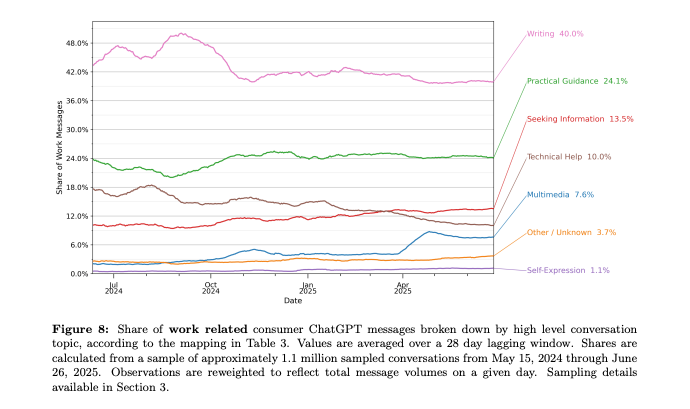
OpenAI’s own research, published as a National Bureau of Economic Research working paper with Harvard economist David Deming, analysed 1.5 million ChatGPT conversations. Nearly 80 percent of all usage fell into just three categories: practical guidance, seeking information, and writing. Writing was the single most common work task, accounting for around 40 percent of work-related messages. And here is the detail I love most: about two-thirds of those writing requests were not asking the AI to create something from scratch. They were asking it to edit, improve, translate or summarise text the user had already written.
In other words, the most common professional use of the most popular AI tool in the world is polishing an email.
Ask yourself honestly: does rewriting a client email, summarising a report, or drafting a slide outline really need this year’s flagship model? Or would the model from twelve months ago, which was already writing at a very high professional standard, do the job just as well?
The performance gap is smaller than the marketing suggests
There is a second uncomfortable truth. Even on demanding tasks, the difference between the newest models and their predecessors is far smaller than the launch events imply.
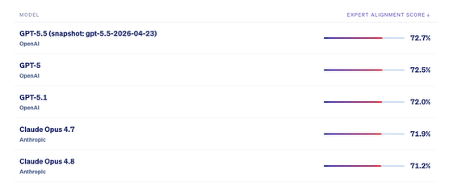
A 2026 study by Pearl https://www.pearl.com/leaderboard, tested 25 leading AI models, including the newest flagship releases from OpenAI and Anthropic, on 510 questions judged by licensed professionals. None of the models exceeded 73 percent. The newest and most expensive models clustered together with the older ones, all just below the threshold where professionals would fully trust them. More expensive, bolder claims, marginal difference.
The benchmark world shows the same pattern. Classic evaluation tests like MMLU (Massive Multitask Language Understanding) are now close to saturated, with top models bunched within a few percentage points of each other. The frontier is still moving on genuinely hard problems such as advanced mathematics, agentic coding and long autonomous tasks. But that is not what most professionals are doing with AI.
For the everyday tasks that dominate real usage, the models converged on “good enough” quite some time ago.
Meanwhile, the price gap has not converged at all. Flagship models typically cost around five times more per token than the mid-tier models from the same company, and premium subscription tiers can cost ten times the standard plan. You are paying a significant premium for capability you will use in perhaps five percent of your tasks.
So why are we obsessed with the latest model?
This is where my marketing and consumer behaviour background becomes useful, because the answer has very little to do with technology.
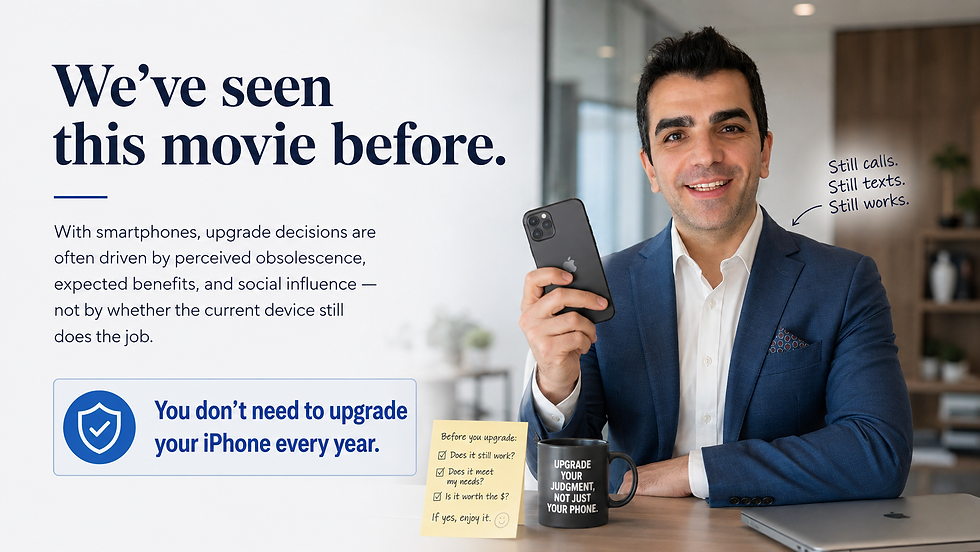
We have seen this movie before with smartphones. Research on smartphone upgrade decisions consistently finds that upgrade intention is driven by perceived obsolescence, expected benefits and social influence, not by an objective analysis of whether the current device still does the job.
So why we are here let me tell you that too you don’t need to upgrade your Iphone every year!
Manufacturers understood this decades ago. Annual launch events, incremental improvements presented as revolutions, and the quiet suggestion that your perfectly functional device is now embarrassingly out of date.
AI companies have inherited the playbook, and several familiar biases do the rest:
• Novelty bias. New things feel more capable simply because they are new. The excitement of the launch transfers to the perceived quality of the output.
• Conspicuous consumption. Thorstein Veblen described this over a century ago. Using the newest, most expensive model signals that you are at the cutting edge. “I use the latest model” has become the professional equivalent of the newest phone on the meeting room table.
• Fear of missing out. If competitors or colleagues are on the newest model, staying on last year’s version feels like falling behind, even when nothing in your actual output would change.
• The safe hedge. Because most people cannot judge in advance which tasks are easy for AI and which are hard, defaulting to the most powerful option feels like insurance. It is a rational response to uncertainty, but it is expensive insurance for tasks a smaller model handles perfectly.
None of this is stupidity. It is bounded rationality in action. We satisfice. Choosing “the newest one” is a cognitive shortcut that saves us from the harder question, which is understanding what we actually need.
The better question: what do you use AI for?
So instead of asking which model is best, ask yourself three questions.
First, what do I actually use AI for? Make an honest list. If it is dominated by email replies, summaries, slide content, meeting notes and routine analysis, congratulations, you are a normal professional user and almost any current model will serve you well.
Second, where does my current tool genuinely fall short? Not “where could it theoretically be better” but where does it fail you on a real task, repeatedly. That is the only signal that should trigger a switch or an upgrade.
Third, is the bottleneck the model or me? Anthropic’s data shows that users with more than six months of experience achieve meaningfully higher success rates than newcomers, and that they work with AI as a thinking partner rather than firing off one-shot instructions. The gap between a skilled user on an older model and an unskilled user on the newest model is enormous, and it favours the skilled user. The learning curve is worth far more than the upgrade.
Which tool for which task?
Do the differences between ChatGPT, Claude, Gemini and Copilot matter at all? At the margins, yes. Each tool has genuine strengths. Claude is excellent at writing, structured thinking and design-oriented outputs, though it is deliberately more conservative on certain image requests such as realistic human faces. ChatGPT is a strong all-rounder with powerful image generation. Gemini integrates naturally with Google Workspace and handles very long documents and multimodal content well. Copilot lives inside Microsoft 365, which makes it the path of least resistance for many corporate environments.
But notice what these differences are. They are fit-for-purpose differences, not intelligence differences. The right question is never “which model is smartest” but “which tool fits this specific task and this specific workflow”.
For ninety-five percent of corporate tasks, all of them are more than capable, and the deciding factor is which one you have actually learned to use well.
The shiny thing in the room
Here is the pattern I want you to notice in your own behaviour. When a new model launches, the shiny thing enters the room and our attention follows it. We ask whether we should have it before we ask whether we need it. It is exactly the mechanism that makes people queue for a phone that is three percent better than the one in their pocket.
The organisations that get real value from AI are not the ones chasing every release. They are the ones that picked capable tools, invested in training their people to use them well, built repeatable workflows around real tasks, and only upgraded when a genuine capability gap appeared. Boring, disciplined, and dramatically more effective.
The frontier matters for researchers, for developers building autonomous agents, and for a small set of genuinely hard problems. For the rest of us, the model from last year writes your emails, analyses your data and builds your slides just fine. The scarce resource is not model capability. It is the human skill to use it well.
The latest model is a want. Knowing what you are doing is the need.
If you want to build that skill in your organisation, this is exactly what my corporate AI training and productivity workshops cover: matching the right tools to the right tasks, building workflows that stick, and avoiding expensive shiny-object decisions. You can find out more and get in touch at www.yusufoc.com.


Comments